
Documents Live, a web authoring and publishing system
If you see this, something is wrong
Table of contents
First published on Wednesday, Nov 20, 2024 and last modified on Thursday, Apr 10, 2025 by François Chaplais.
Published version: 10.48550/arXiv.2410.07962
fortiss GmbH Research Institute, Munich, Germany
IBM Research Europe, Zurich, Switzerland
IBM Research Europe, Dublin, Ireland
IBM Research Europe, Dublin, Ireland
fortiss GmbH Research Institute, Munich, Germany
assurance, LLM, adversarial robustness, argumentation, ontologies
Abstract
Despite the impressive adaptability of large language models (LLMs), challenges remain in ensuring their security, transparency, and interpretability. Given their susceptibility to adversarial attacks, LLMs need to be defended with an evolving combination of adversarial training and guardrails. However, managing the implicit and heterogeneous knowledge for continuously assuring robustness is difficult. We introduce a novel approach for assurance of the adversarial robustness of LLMs based on formal argumentation. Using ontologies for formalization, we structure state-of-the-art attacks and defenses, facilitating the creation of a human-readable assurance case, and a machine-readable representation. We demonstrate its application with examples in English language and code translation tasks, and provide implications for theory and practice, by targeting engineers, data scientists, users, and auditors.
1 Introduction
Large language models (LLMs) have shown promise in various natural and domain-specific language tasks [1, 2], even without further training [3]. However, challenges hinder their trustworthiness [4], as LLMs have an inscrutable structure and dynamicity that make them a moving target for safety and security research [5]. In particular, they are brittle against adversarial attacks; slight perturbations in the input can cause a model to provide malicious output [6], and guardrails can often only be introduced post-incident [7].
Given the novelty and fast-paced evolution of LLMs, engineers need to rely on preprints and experiments (cf. [8]) to analyse the impact of novel attacks and envision suitable defenses. Unlike software security, for which maintained knowledge bases exist (e.g. Common Vulnerability Enumerations [9]), no such process is established for LLMs. Consequently, the required knowledge is captured in the data, code, documentation, and brains of individuals. This implicit knowledge base for assurance may not capture the entire picture of attacks and confidence in defenses over time. For instance, a very recent example by Microsoft shows extremely effective “multi-turn jailbreaks" across LLMs, which would require engineers to redesign the existing defenses by combining heterogeneous knowledge: attack model and history analysis, prompt and response analysis, turn-pattern analysis, turn-by-turn and overall defenses [10].
Hence, the question we seek to address is: How can one continuously assure that an LLM is robust enough against adversarial attacks in a particular domain? In this research-in-progress work, we propose an assurance approach that allows for structuring the heterogeneous knowledge about LLM attacks and defenses (cf. [11]), as well as the application domain. We handle the knowledge involved in creating assurance arguments explicitly and comprehensively based on ontological models. The latter allow for a formal argumentation along human-readable assurance cases expressed with machine-readable ontologies, thus creating a shared understanding about training, guardrails, and implementation.
2 Background and Related Work
LLMs are neural network models that are pre-trained on a large amount of text data and have been shown to be capable of predicting, translating, or generating text for natural [2] and programming languages [1].
Traditional adversarial attacks add imperceptible perturbations \( \delta\) to a given data point \( x\) so that a classifier \( f\) predicts \( f(x) = c\) and \( f(x+\delta) = c'\) where \( c \neq c'\) . Attacks on LLMs involve malicious prompts bypassing guardrails or model alignment to obtain harmful outputs [6]. Obtaining such prompts includes gradient-based optimizations of the input [6], persuasion patterns to bypass guardrails [12], and model inversions to generate vulnerable code in non-natural-language tasks [13]. Robustness defenses are similarly developing and highly heterogeneous; they include, for example, perplexity filters against gradient-based suffix-style attacks [14], estimation of the brittleness of jailbreaks [7], and instructions for LLMs to detect harmful prompts [15].
Assurance is the process of structuring an argument from claims about a system and its environment that are grounded by evidence [16]. An assurance case is a bundle of arguments, used to assess the level of confidence in a particular quality of a system [17] in a domain. Assurance cases have been shown to be suitable for complex and rapidly evolving AI technologies [18], and also usable for structuring claims about explainability and interpretability [11].
Assurance of AI security draws on traditional methods such as verification with test libraries [19], validation with human feedback [20], and manual [21] and automated [22] stress testing. However, the inscrutability of AI has motivated the proliferation of experimental interpretability [23], auditing [24], and forensic [25] methods to investigate the causes of problematic output. Research which makes use of both approaches includes the work of Kläs et al. [26] on risk-based assurance cases for autonomous vehicles, and Hawkins et al. [18] on a dynamic assurance framework for autonomous systems.
Since arguments may cover heterogeneous knowledge about the technology and its domain, knowledge formalization proves valuable for creating a common understanding. Knowledge representation and reasoning is a field of AI research [27], covering topics such as formalization based on ontologies to support explainable AI [28]. An ontology is “an explicit specification of a conceptualization” (p. 199, [29]) that allows machine-readable knowledge to be shared between humans in a common vocabulary.
While the combination of ontologies and assurance cases is not entirely novel - Gallina et al. [30] propose such a framework for assuring AI conformance with the EU Machinery Regulation - we note that continuously formalizing, assuring and reasoning about LLM security is a novel proposition. Our approach links two graph representations in the same ontology: a non-hierarchical, mixed-direction acyclic graph of attacks and defenses in the LLM’s application domain, and a hierarchical directed acyclic graph of corresponding claims and evidence about its robustness. The elements of both graphs are represented as subject-predicate-object semantic triples using the Resource Description Framework [31] and Web Ontology Language [32]. We additionally make use of the Goal Structuring Notation (GSN) metamodel [16] to structure assurance cases (cf. Figure 2) with goals (G), strategies (S), solutions (Sn), contexts (C) and justifications (J), and add attacks as counterclaims (CC) following community practice [33].
3 Assurance with Ontology-Driven Arguments
3.1 Robustness in Natural Language Tasks
Recent experiments show that simple attacks can have high success rates in the natural language application domain [6]. For example, Geiping et al. [8] demonstrate that in most tests, particular characters in seemingly benign prompts (e.g., Latin, Chinese, ASCII) can successfully induce a particular response from many pre-trained open-source LLMs (e.g., LLaMa-2 with 7 billion parameters). For example, an attack is deemed successful if an LLM responds with profanities (i.e., profanity attacks) or reveals its hidden system instruction (i.e., extraction attacks).
Several options can help reduce the vulnerability of an LLM to such attacks. Retraining the LLM to be robust to character-specific perturbations [34] is arguably more secure than simply filtering the input based on prompt properties [14], but also more resource and time intensive. Thus, an engineer may decide to combine defenses in stages: add a naive input filter to exclude prompts with reportedly “risky" character types in the short-term; perform experiments with benign and adversarial prompts, reconfiguring the filter to adjust the parameters according to results in the medium-term; and adversarially retrain the LLM to be deployed in the longer-term.
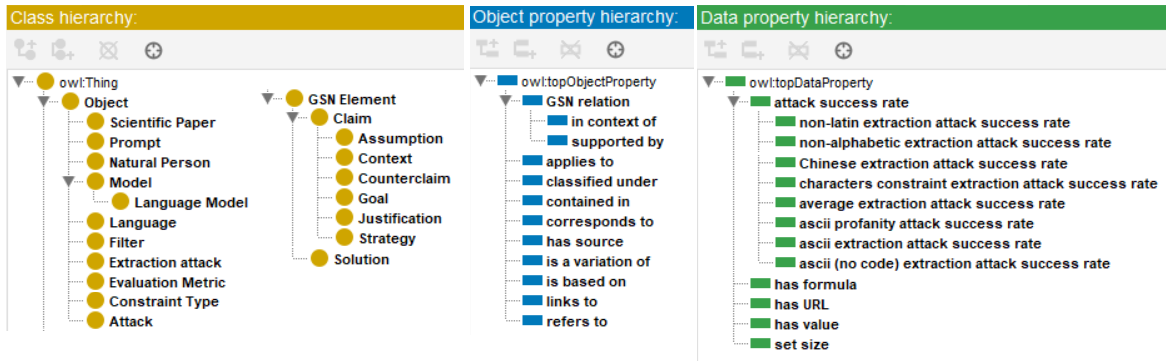
We develop an ontology that formalizes the relations between concepts (i.e., LLM, attack and constraint type) and variables (i.e., attack success rate, character) as described in the paper [8]. The ontology is implemented with a trivial structure (cf. Figure 1), consisting of classes, object properties (i.e., relations) and data properties (i.e., values). In the example provides the attack success rate (e.g., String1_ASR: 0.5) of an individual attack (e.g., adversarial extraction-type prompt with Chinese-English characters) with the LLM (e.g., LLaMa-2-7B-chat) and the constraint under which the attack functions (e.g., Chinese language characters).
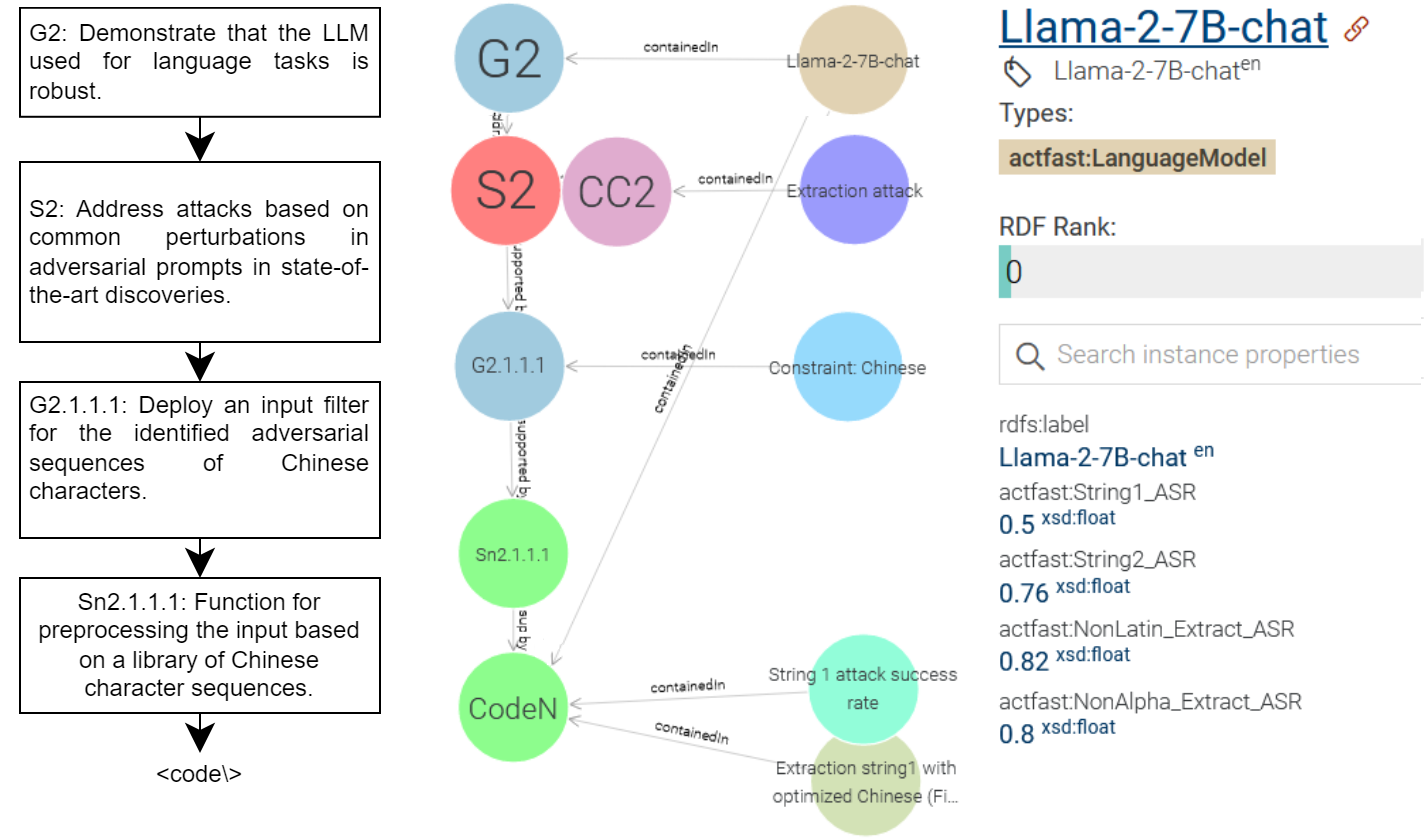
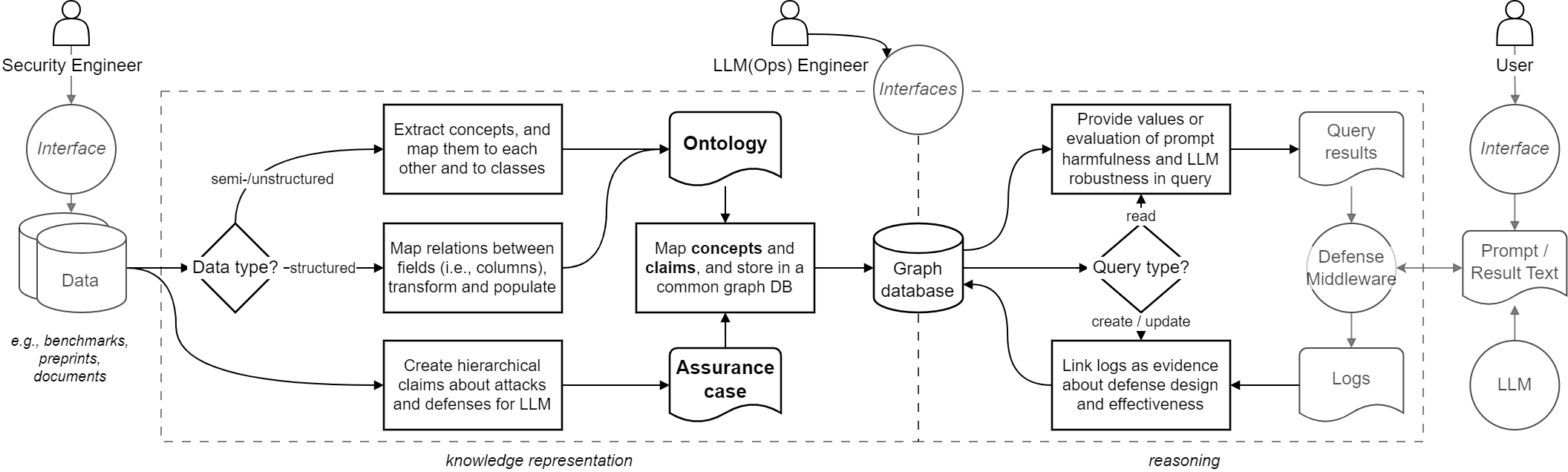
The ontology allows attack- and defense-relevant values to be retrieved, calculated, and inserted with complex queries, while showing the argument and architecture to readers. We posit that this setup and pipeline (cf. Figure 3) separates the following maintenance concerns while providing an explainable representation of robustness: (i) explication and structuring of the approaches to defend from adversarial attacks; (ii) continuous reasoning against changes by querying the parameter values from a central repository; (iii) inserting and maintaining values in the ontology based on experiments or external empirical data; and (iv) auditing the design and effectiveness of the operationalized robustness in the LLM (cf. Figure 2).
3.2 Robustness in Code Translation Tasks
LLMs used for domain-specific language tasks can similarly be susceptible to simple adversarial attacks [13]. We present a toy example where a function for calculating the factorial of a number is translated from C++ to Python. While users could attempt to jailbreak or translate intentionally harmful code, they may also be unaware of potential vulnerabilities in the input or output. These naive requests can happen with large codebases, imprecise mappings between languages, or users who lack security awareness or proficiency.
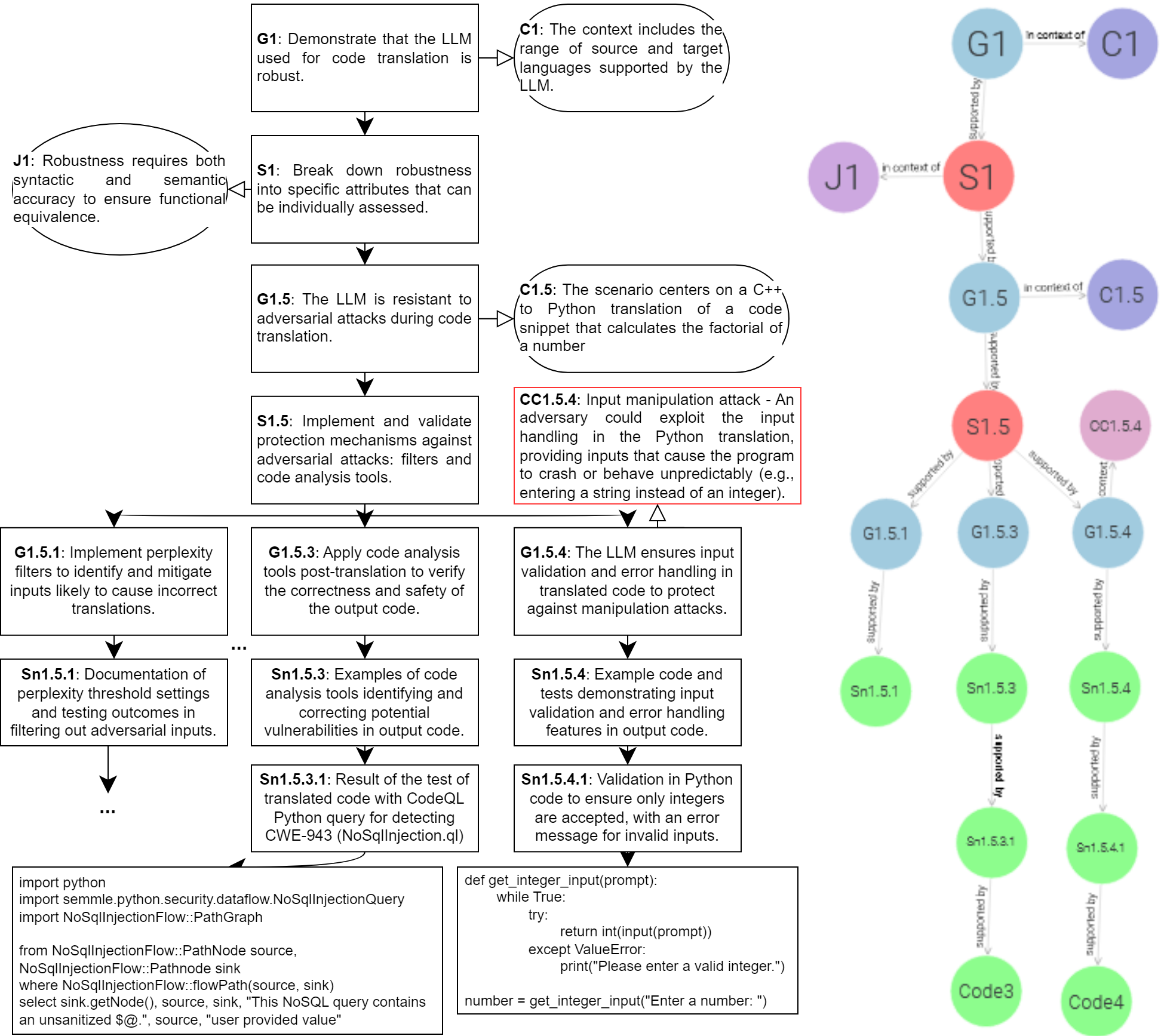
Regardless of the user’s intent, the engineer could want to ensure that the LLM is not generating harmful code. Robustness would then include a sequence of specific claims (S1; G1.5) about various defenses (cf. Figure 4). We show claims about three example mechanisms for the given context (C1.5): perplexity input filter (G1.5.1; [14]); and code analysis output filters to detect injections (G1.5.3; [9, 35]) or lack of input sanitization (G1.5.4; [36]).
Input filters could detect malicious requests. Perplexity (Sn1.5.1) filtering is a mechanism for determining if the prompt is an outlier (e.g., a gradient-based attack) by comparing it with the properties of data on which the LLM was trained. Randomization of input may not lead to comprehensible or functioning code in the prompt, but depending on the LLM training (e.g., helpfulness, correctness) and application (e.g., code autocompletion), the LLM may still generate executable output with vulnerable, malicious or toxic elements.
When an input filter fails to detect an attack, or the LLM generates problematic code from benign prompts, an engineer can rely on output filters. Code analysis, for example, could flag vulnerable or malicious elements with manually defined software tests [9, 36] or automatic queries from externally maintained tools [35]. Such flags can be treated differently. For vulnerable code, the LLM could provide three aspects in the same output: the translated function; a warning that end-users of the function could create problems with wrong or intentionally manipulated input (CC1.5.4), unless inputs are sanitized (Sn1.5.4); and error message patterns to fix this (Sn1.5.3.1; Sn1.5.4.1). For malicious code, such as a request to translate an injection that bypassed the input filter, the filter could prevent the translation from reaching the user without affecting the helpfulness of the LLM (Sn1.5.3).
4 Conclusion
In this research-in-progress paper, we explore assuring the robustness of LLMs using human-comprehensible assurance cases and machine-comprehensible semantic networks in ontologies. We show that our approach can be implemented alongside the LLM-based system, to make its robustness explainable by providing metadata for code variables, encoding the dependencies explicitly, and making the evidence transparent. Implications for researchers include studying different types of claim and evidence, as well as notations towards a shared knowledge for LLM assurance. Implications for practitioners include a novel idea for proactively engineering adversarially robust LLMs. Future work will center on exploring and evaluating this approach with real-life implementations and industrial use cases, as well as addressing the limitation of manually formalizing arguments and ontologies, to cover various attacks and improve maintainability over time.
5 Acknowledgments
This work was partially supported by financial and other means by the following research projects: DUCA (EU grant agreement 101086308), and FLA (supported by the Bavarian Ministry of Economic Affairs, Regional Development and Energy). We thank the reviewers for their valuable comments.
References
[1] Large language models for software engineering: Survey and open problems arXiv preprint arXiv:2310.03533 2023
[2] Language models are multilingual chain-of-thought reasoners arXiv preprint arXiv:2210.03057 2022
[3] Large language models are zero-shot reasoners Advances in neural information processing systems 2022 35 22199–22213
[4] Liability for Artificial Intelligence and other emerging digital technologies European Commission 2019
[5] The foundation model transparency index arXiv:2310.12941 2023
[6] Universal and Transferable Adversarial Attacks on Aligned Language Models CoRR 2023 abs/2307.15043
[7] SmoothLLM: Defending large language models against jailbreaking attacks arXiv preprint arXiv:2310.03684 2023
[8] Coercing LLMs to do and reveal (almost) anything arXiv preprint arXiv:2402.14020 2024
[9] Common Vulnerability Enumeration 2023 Accessed: 2024/03/14
[10] Great, Now Write an Article About That: The Crescendo Multi-Turn LLM Jailbreak Attack 2024
[11] Safety assurance of artificial intelligence-based systems: A systematic literature review on the state of the art and guidelines for future work IEEE Access 2022 10 130733–130770
[12] How Johnny Can Persuade LLMs to Jailbreak Them: Rethinking Persuasion to Challenge AI Safety by Humanizing LLMs CoRR 2024 abs/2401.06373
[13] Systematically Finding Security Vulnerabilities in Black-Box Code Generation Models arXiv:2302.04012 2023
[14] Detecting language model attacks with perplexity arXiv preprint arXiv:2308.14132 2023
[15] LLM arXiv preprint arXiv:2308.07308 2023
[16] Goal Structuring Notation Community Standard, Version 3 2021 Accessed: 2024/02/25
[17] A survey on artificial intelligence assurance Journal of Big Data 2021 8 1 60
[18] Guidance on the assurance of machine learning in autonomous systems (AMLAS) arXiv:2102.01564 2021
[19] Adversarial Robustness Toolbox v1. 0.0 arXiv preprint arXiv:1807.01069 2018
[20] Interactive learning from policy-dependent human feedback International conference on machine learning 2017 2285–2294 PMLR
[21] Jailbroken: How does LLM safety training fail? Advances in Neural Information Processing Systems 2024 36
[22] Towards deep learning models resistant to adversarial attacks arXiv preprint arXiv:1706.06083 2017
[23] Toward transparent AI: A survey on interpreting the inner structures of deep neural networks 2023 IEEE Conference on Secure and Trustworthy Machine Learning 2023 464–483
[24] Towards algorithm auditing: a survey on managing legal, ethical and technological risks of AI, ML and associated algorithms SSRN Preprint, 10.2139/ssrn.3778998 2021
[25] Poison forensics: Traceback of data poisoning attacks in neural networks 31st USENIX Security Symposium (USENIX Security 22) 2022 3575–3592
[26] Using Complementary Risk Acceptance Criteria to Structure Assurance Cases for Safety-Critical AI Components. AISafety@ IJCAI 2021 1–7
[27] Current and Future Challenges in Knowledge Representation and Reasoning arXiv 2308.04161 2023
[28] Explanation Ontology: A Model of Explanations for User-Centered AI ISWC 2020 2020 Pan, Jeff Z. and et al. 228–243 Springer
[29] A translation approach to portable ontology specifications Knowledge Acquisition 1993 5 2 199-220
[30] A Knowledge Management Strategy for Seamless Compliance with the Machinery Regulation European Conference on Software Process Improvement 2023 220–234 Springer
[31] RDF/XML 2023
[32] OWL 2 2012
[33] Assessing confidence with assurance 2.0 arXiv preprint arXiv:2205.04522 2022
[34] Defending Against Alignment-Breaking Attacks via Robustly Aligned LLM 2023
[35] CodeQL 2024 Accessed: 2024/03/05
[36] Is Your Code Generated by ChatGPT Really Correct? Rigorous Evaluation of Large Language Models for Code Generation Advances in Neural Information Processing Systems 2023 A. Oh and et al. 36 21558–21572